
 6.0
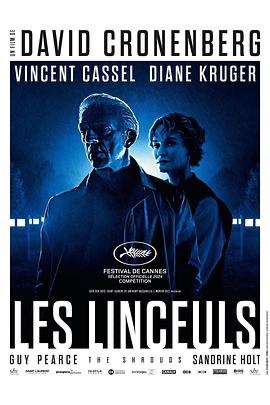
6.0The Shrouds
Story Overview
Jun 25, 2025The male lead, Kash, is a creative businessman and a grieving widower. He has built a device that allows communication with the deceased through a shroud wrapped around their body in the grave. As Kash's groundbreaking invention is about to enter the international spotlight, several graves, including that of his wife, are deliberately vandalized and nearly destroyed. Kash struggles to uncover the truth behind the attack, while reality forces him to reassess his work, his marriage, and his loyalty to the memory of his late wife, all of which push him toward a new beginning.
Review Highlights
5 entriesCronenberg has regained some edge
10.0Since *Crash*, Cronenberg has moved away from focusing on the bodily externalization of horror and instead internalized them (future crimes are scripts from the past).
Cronenberg has regained some edge
Since *Crash*, Cronenberg has moved away from focusing on the bodily externalization of horror and instead internalized them (future crimes are scripts from the past).
Since *Crash*, Cronenberg has moved away from focusing on the bodily externalization of horror and instead internalized them (future crimes are scripts from the past).
*Shroud* combines mourning behaviors with the fear of conspiracy theories. Both point to the same thing: it damages the body, infinitely enhancing the horror, always attempting to uncover the truth. However, as multiple truths open up, they only highlight the subject’s incompetence.
To mourn, we have to experience more; to explain the conspiracy, we have to experience more. This, in turn, leads to the enhancement of meaning, but it delays the understanding of the conspiracy and the mourning process, making it impossible to end.
Yet, everything remains endless and inexplicable, even the simplest fact: a person has died, and now only a body remains. That person has vanished from this world, no longer existing.
The visual body and the tactile body, the truth expressed through media (mobile phones), and the truth expressed through AI interweave. Throughout the process, it has become connected with everything.
The mourning behavior involves biology, artificial intelligence, computers, economics, and geopolitics, all following a winding path, just like the production of conspiracy theories, but it never ends anything.
Only letting go is considered an end. Mourning, as a form of hatred, internalizes the deceased within oneself, punishing oneself, so that the one who cannot be harmed can no longer be hurt. At first, we may think that the husband is completely loyal to his wife, but later we realize that it’s not that simple. He’s trapped in a terrifying fantasy about whether his wife betrayed him, which is precisely a form of conspiracy theory.
But the ex-husband, a conspiracy theorist, can’t truly attract his sister, who is madly in love with conspiracy theories. Clearly, he’s a real fool, and this type of fool is not loved by his sister. This also points out that mourning behavior itself follows this kind of conspiracy theory trajectory.
I’ve seen the same behavior in my mother, who came up with various explanations for her sister’s death. But without exception, she also showed a tendency for conspiracy theories, unwilling to give up on certain perplexities, repeating them, unable to cross over or let go. (Personally, I don’t think some pain must be let go.)
We adopt such an indirect strategy. Mourning only points to the body, but mourning rejects the body.
Just as AI once said, when wrapping oneself in the shroud, the experience is unrelated to the body because the body belongs to the deceased, and the shroud is what the deceased used.
It’s not about the user’s tactile skin and the touch of the shroud, but about the user’s visual experience, seeing the process of decay through a phone and screen. As the user, you can only view from the outside and can’t wear the shroud yourself. In this process, the body is just a body.
Therefore, the result of mourning can only be letting go. Unless we’re forever immersed in this conspiracy theory.
When the protagonist finally gives up on the impulse to understand the conspiracy, he also lets go of his wife’s body.
The only thing we get is simply that the person has died, and that’s it. Everything else is just mourning or letting go.
This kind of story still has certain flaws, as Cronenberg’s films often end abruptly or completely dissipate by the end.
1. Cronenberg’s old white male interests remain. 2. Cronenberg’s intimate scenes are still stunning. 3. Cronenberg’s thriller handling remains stimulating. 4. Cronenberg embraces digital photography techniques (which means that the "idiotic dog poop" special effects in the star map were intentional, especially for a master of suspense like Cronenberg). 5. Cronenberg seems to have fully immersed himself in films with an overwhelming amount of dialogue.
Le glas est sonné
4.0Linceuls laisse voir un Cronenberg agonisant qui semble inscrire ici l'épitaphe de sa carrière de réalisateur voire tisser le drap mortuaire de son propre cinéma, désormais guindé et vidé de substance. L'obsession d'antan sur la métamorphose du corps, gagnée par un imaginaire décharné, se décompose totalement au profit d'un registre parano-complotiste perméable à la confusion volontaire et à la complexité gratuite sans pour autant accoucher d'une consistance.
Le glas est sonné
Linceuls laisse voir un Cronenberg agonisant qui semble inscrire ici l'épitaphe de sa carrière de réalisateur voire tisser le drap mortuaire de son propre cinéma, désormais guindé et vidé de substance. L'obsession d'antan sur la métamorphose du corps, gagnée par un imaginaire décharné, se décompose totalement au profit d'un registre parano-complotiste perméable à la confusion volontaire et à la complexité gratuite sans pour autant accoucher d'une consistance.
Linceuls laisse voir un Cronenberg agonisant qui semble inscrire ici l'épitaphe de sa carrière de réalisateur voire tisser le drap mortuaire de son propre cinéma, désormais guindé et vidé de substance. L'obsession d'antan sur la métamorphose du corps, gagnée par un imaginaire décharné, se décompose totalement au profit d'un registre parano-complotiste perméable à la confusion volontaire et à la complexité gratuite sans pour autant accoucher d'une consistance.
This building provides shelter from the wind
8.0*Shroud* reminds me of the Western fantasy tradition of "holy relics," the madness of medieval medicine, and Cronenberg's usual psychological state (as my friends and I were joking, this building serves as a refuge). But what made me like this film? You can see a tragic, perverse love for the dead and the decayed: how many forms of unrest and tangled mess can one endure after death? Kash manages to explain all of this on the body of a buried corpse.
This building provides shelter from the wind
*Shroud* reminds me of the Western fantasy tradition of "holy relics," the madness of medieval medicine, and Cronenberg's usual psychological state (as my friends and I were joking, this building serves as a refuge). But what made me like this film? You can see a tragic, perverse love for the dead and the decayed: how many forms of unrest and tangled mess can one endure after death? Kash manages to explain all of this on the body of a buried corpse.
*Shroud* reminds me of the Western fantasy tradition of "holy relics," the madness of medieval medicine, and Cronenberg's usual psychological state (as my friends and I were joking, this building serves as a refuge). But what made me like this film? You can see a tragic, perverse love for the dead and the decayed: how many forms of unrest and tangled mess can one endure after death? Kash manages to explain all of this on the body of a buried corpse.
**The Shift from Body to Mind:** Cronenberg moves from exploring the distortion of the human body by environmental pollution in *Future Crimes* to the mutation of moral sense caused by technological advancement in *Shroud*. The protagonist, Kash, fixates on his wife’s remains, even using "MRI shrouds" to peer into her bones, discovering the “electronic growths” created by technology. These growths are like the electronic phantom limbs created by a human’s phone in life—after death, technology merges with the human flesh, continuing into the grave. How can one still be misunderstood and distorted after death?
**Abnormal Love and Distortion:** After his wife’s death, Kash digs into her electronic traces, uncovering secrets she kept during her life. This exploration is both a violation of his wife’s memory and a struggle with his own emotions. For example, he fantasizes about his wife’s disfigured image, reflecting an abnormal attachment to the deceased. His vision of her is death-ridden and incomplete, and this obsession with her "incomplete" state becomes a mental dilemma. By using technology to peer into his late wife’s existence, he essentially destroys her secrets from her life—he is still desperately trying to reconstruct her image through photos, audio recordings, and relationships, leading to possessiveness and obsessive love.
**Respecting the Resting Place of the Dead:** Through the "shroud," the film explores how technology invades the boundaries of the deceased, reflecting on the nihilism of religious views on death. Kash’s actions are not just about uncovering his late wife, but also redefining death and memory. Though AI virtual assistants can help Kash reconstruct his wife’s body, they also bring him dreams or punishment. While he can peer into her bones through the shroud, he is repeatedly forced to endure memories of his wife’s right breast, hip, and arm being removed individually. It's reminiscent of the anatomist in *Cloud Atlas* who can never resolve his phantom limb pain—just as the wife was not laid to rest, Kash is doomed to a continuous, unresolvable cycle of torment with his wife’s remains.
**The "Enlightenment" Perspective on Kash’s Logic:** From an “enlightenment” perspective, Kash’s logic presents an inherent contradiction: it embodies the sense of having “understood yet not understood.” He realizes the interpenetration of technology and emotion but also presents an obsessive, self-destructive pursuit. Kash’s digital voyeurism of his wife’s remains is, on one hand, a rejection of religious views on death, and on the other, an invasion of the final boundaries of humanity by technology. It’s as if Kash places himself into the shroud, dissecting and reflecting on his feelings for his late wife as if they were "corpse-like." Both paths—one of obsession and the other of self-destruction—lead to the same twisted, destructive road.
The Known and the Unknown
8.0Karsh is unable to truly connect with others; he seems to exist in a separate space from everyone else. Even when he engages in sexual relationships, their conversations are disjointed, unable to flow. When not in the same physical space, this "absence in presence" feeling becomes even more apparent, especially when interacting over the internet. Everyone appears as an isolated individual, each living in their own world.
The Known and the Unknown
Karsh is unable to truly connect with others; he seems to exist in a separate space from everyone else. Even when he engages in sexual relationships, their conversations are disjointed, unable to flow. When not in the same physical space, this "absence in presence" feeling becomes even more apparent, especially when interacting over the internet. Everyone appears as an isolated individual, each living in their own world.
Karsh is unable to truly connect with others; he seems to exist in a separate space from everyone else. Even when he engages in sexual relationships, their conversations are disjointed, unable to flow. When not in the same physical space, this "absence in presence" feeling becomes even more apparent, especially when interacting over the internet. Everyone appears as an isolated individual, each living in their own world.
When the truth is unknown, every thought becomes a conspiracy theory, which in turn leads to another person. Each independent existence introduces a new conspiracy theory, and a new network of connections forms. As the film describes it, the "mashed mash" (a mesh of networks) is formed, where networks exist within networks. We can no longer know the truth or trust anyone. The more conspiracy theories there are, the more they remain just that—conspiracy theories. The facts are unknown, and we can only learn from the known.
What we do know is this: Karsh accepts his wife’s death in his own way, relying on technology to achieve a form of immortality and to accept death. He is loyal to his wife, yet he does not mind, and even enjoys, engaging with other women, especially sexually. His approach to all of this is inaction (using the law as an excuse). He never takes effective action; all he does is let AI handle everything. Even regarding the psychological matter of his romantic rival and his wife being forever buried together, Karsh chooses to bury her elsewhere. He is unsure whether what he is doing is right, uncertain of the truth, and unclear about his true desires, but his actions reflect his inner turmoil.
This is a minimalist postmodern film, where Cronenberg uses minimalism to reflect complexity. The story at the end can continue indefinitely; any attempt to end it only serves as proof of the story’s infinite nature. It leads into the void, leaving us to only pick up fragmented truths from each fleeting word and action.
A little disappointed
6.0Under the control of Cronenberg,the movie still has the atomsphere of a suspense movie nearly all the time. But the story actually,is exhausting.The contractions are concerntrated in the final stages,so it makes the strcture is not very comfortable for me.
A little disappointed
Under the control of Cronenberg,the movie still has the atomsphere of a suspense movie nearly all the time. But the story actually,is exhausting.The contractions are concerntrated in the final stages,so it makes the strcture is not very comfortable for me.
Under the control of Cronenberg,the movie still has the atomsphere of a suspense movie nearly all the time. But the story actually,is exhausting.The contractions are concerntrated in the final stages,so it makes the strcture is not very comfortable for me.
And the most important thing is.The issues it wants to explore are quite profound and philosophical,involving core topics such as humanity,life,society and conspiracy theory etc.But unfortunately I can‘t fully appreciate the depth of the direcor‘s ideas,most of which are superficial,especially with too many gimmicks.So a little disappointed sincerely.