
 5.8
5.8The Running Man
Story Overview
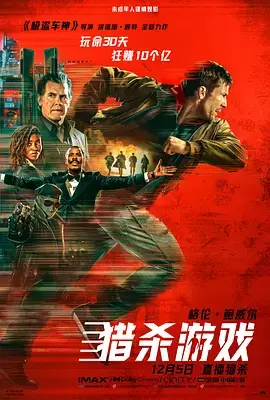
Mar 5, 2026In a near-future dystopian society, the reality TV show *The Running Man* dominates the ratings with its bloody survival competition. Contestants, known as "Runners," must survive for 30 days while being hunted by professional killers, their every move broadcast live to a bloodthirsty public. Each extra day they survive accumulates a larger prize. Ben Richards (Glen Powell), a working-class man desperate to save his critically ill daughter, is persuaded by the show's charismatic yet ruthless producer, Dan Killian (Josh Brolin), to enter this deadly game as the "last hope." However, Ben's rebellious spirit, survival instincts, and unwavering will unexpectedly make him a national idol—and simultaneously a deadly threat to the entire system. As ratings soar to their peak, the danger level skyrockets. Ben must not only outsmart the relentlessly pursuing hunters but also contend with the nation's frenzied expectation of his "utter defeat." The film is adapted from Stephen King's novel of the same name.
Review Highlights
5 entriesFor the average viewer, this movie is definitely passable and not bad. Unfortunately, there are too many pretentious people on Douban!
4.0I went to see it in the cinema today, and it wasn't as bad as I thought. The plot and action weren't too embarrassingly bad; I'd give it a 7 out of 10.
For the average viewer, this movie is definitely passable and not bad. Unfortunately, there are too many pretentious people on Douban!
I went to see it in the cinema today, and it wasn't as bad as I thought. The plot and action weren't too embarrassingly bad; I'd give it a 7 out of 10.
I went to see it in the cinema today, and it wasn't as bad as I thought. The plot and action weren't too embarrassingly bad; I'd give it a 7 out of 10.
It's a shame that Douban is full of pretentious people who mindlessly belittle it to make themselves look superior. My disillusionment with Douban started over ten years ago with a pretentious movie called *Mr.
Six*. The entire film was pretentious with not a single real fight scene.
The action scenes and plot suspense were nowhere near as good as *The Hunt*, yet a bunch of pretentious people on Douban gave it an 8-point rating, which shocked me. From then on, I realized Douban is a haven for pretentious people.
Screw you pretentious bastards!
It's a farce caused by the TV station letting a grumpy male protagonist get away with things; just watch it for fun.
3.0版权归作者所有,任何形式转载请联系作者。 作者:梦到哪句写哪句(来自豆瓣) 来源:https://movie.douban.com/review/17343233/
It's a farce caused by the TV station letting a grumpy male protagonist get away with things; just watch it for fun.
版权归作者所有,任何形式转载请联系作者。 作者:梦到哪句写哪句(来自豆瓣) 来源:https://movie.douban.com/review/17343233/
版权归作者所有,任何形式转载请联系作者。 作者:梦到哪句写哪句(来自豆瓣) 来源:https://movie.douban.com/review/17343233/
The film's protagonist's success relies entirely on the logic of lower-class people helping each other. There are no instances of people openly helping him while secretly plotting to take his money, or, like the taxi driver, shouting to attract attention after watching the commotion. The only time he reports someone is when the bespectacled man, along with his mother, goes crazy and presses the button; the time he chases after the garbage collector without calling the report counts. Furthermore, the garbage collector's probing is so obvious that even a fool could see it, yet the protagonist knocks him down but doesn't finish him off, waiting for the garbage collector to catch up and then unleashing a helpless rage at the protagonist escaping across the train tracks. If the iron gate the protagonist passed through before going to the TV station was a barrier separating the rich and poor, then how did he suddenly slip from the rich area to the poor area to buy equipment from someone he knew, without ever passing through that gate again during the escape game? He couldn't have automatically passed through the barrier by getting into a taxi, could he? Aren't the rich areas separated from the poor areas? Moreover, all the actors in the film perform by shouting and yelling in anger, except for the protagonist's wife, children, and the old man at the TV station, who manage to speak reasonably. Most of the other characters were just competing to see who could shout the loudest, making the whole film noisy from beginning to end. Fortunately, the world quieted down after the protagonist's wife appeared. I thought the protagonist would sleep in the unsafe-looking safe house and then pull off something big, but he was still pushed around by the show. His only attempt to use a handbag as a bomb was easily seen through. I could accept that he secretly took a bag of explosives when he was asking about them at the beginning. But he had nothing and was just bluffing, which was purely for laughs. And the villa guy who appeared later was clearly not from the lower class, so why did he unconditionally help the protagonist? You said your father's revenge was done by his colleagues, so why didn't you go after them all these years? The people chasing the protagonist aren't the same ones from back then, so what's the point of going after them? Besides, your traps weren't even lethal. The funniest part was the villa scene. They looked like they couldn't be electrocuted, yet the pursuers actually fell to the ground. A bunch of them tripped and fell down the wooden stairs from the second floor – it felt absurd, like children playing house actually taking down well-equipped special forces. Throughout the villa scene, the protagonist kept asking the bespectacled man what to do next, and when the bespectacled man was busy and didn't respond, he asked twice. The villa was so small, yet the protagonist still blinked his big eyes and asked the bespectacled man, "Did you bring me up here just to slide down?" Why don't you just fly out and run away yourself? He's helping you and then complaining about everything. Although the bespectacled man is a bit crazy, at least he's willing to help. The only cool moment for the protagonist in the whole film wasn't the two explosions or the video recording where he made threats and gave the middle finger, but rather his streaking through the apartment building. Swinging from the rooftop to the room to get his bag while keeping his towel intact, and then tearing off the towel to smash the window – although we didn't see his private parts, sacrificing his modesty to protect his fist from cuts by glass – I salute you as a true man! 👍 Of course, it's possible that after running around naked for so long, people just let loose and didn't care about covering up anymore. Finally, they said it was for a TV show and even held an audition. When the male lead was wearing red, there were clearly other teams wearing different colors, but they only filmed the three of them. But I didn't sense any deep friendship between them. The male lead could only watch the replays of the other two's deaths on TV. One of them stupidly exposed himself and died, and the other spent all his money before dying. It would have been better if the male lead hadn't died. After the plane was about to crash, the film relied entirely on the masked man's words to make things right. To me, it would have been more satisfying if the male lead had died but lit the detonator. This kind of plot focuses entirely on whether the male lead is dead or not, which is very boring. Also, the woman on the plane said she wanted to be a good person, but when the male lead and the villain were fighting to the death, she didn't take sides. She just stood there holding her parachute the whole time. It's the first time I've seen a background character who does absolutely nothing in crucial plot points; they should have just killed her off. Cut the last 10 minutes of the film; just end it with the male lead dying in a plane crash. The later resistance is there, but what's the point of smashing up the TV station? Once that station collapses, they can always find new entertainment. Besides, the male lead, even if he lives to become a leader, is still just a reckless fool; he'd be better off dead.
The Life-Pricing of Surplus Labor: The Hunt Game in a New Stage of Capitalism
3.0版权归作者所有,任何形式转载请联系作者。 作者:Tertius(来自豆瓣) 来源:https://movie.douban.com/review/17306852/
The Life-Pricing of Surplus Labor: The Hunt Game in a New Stage of Capitalism
版权归作者所有,任何形式转载请联系作者。 作者:Tertius(来自豆瓣) 来源:https://movie.douban.com/review/17306852/
版权归作者所有,任何形式转载请联系作者。 作者:Tertius(来自豆瓣) 来源:https://movie.douban.com/review/17306852/
I watched the newly released film *The Hunt* today. Overall, while the film may seem mediocre to some extent, it is undoubtedly a typical example of a contemporary film that flexibly incorporates the latest social issues. The film reflects contemporary reflections on media tyranny, especially after capitalism has developed to a new stage, where the human body and life have become objects of capitalist consumption in the process of labor reproduction. These two points precisely capture the very contemporary characteristics of economic development and cultural reproduction.
First, from a media perspective, the film reflects on the idea that we live in a world of total surveillance, a concept similar to the metaphors in *The Truman Show* or the Chinese film *The Unknown*. We are surrounded by a world spied on through media terminals—especially screens. While *The Truman Show* did not depict such direct surveillance and consumption, later works with a Korean setting, such as *The Squid Game*, and this year's *The Hunt*, show death performances dominated by capitalists. These capitalized struggles for life and death are presented not only through surveillance and games but also, through the revival of traditional concepts like "hero" and "knight," reveal modern society's yearning for traditional values such as sacrifice and family honor.
This film highlights core values: a father risking his life to save his sick daughter, and the necessity for men to shoulder family responsibilities. But more importantly, it presents a media-driven dystopia. In the film, the media not only shapes our perspective on things but also meticulously designs what we can and cannot see. Who is portrayed as a hero and who is depicted as an executioner is not determined by ourselves but by capital.
This process of "watching" is itself a manifestation of media reflexivity. When we see characters watching on screen, and when we voyeurize through the medium of film, we also see how humanity's voyeuristic desires gradually evolve into a yearning to watch others die. Life and death become a gamble, part of the performance. This phenomenon reflects the close connection between media consumption and the entertainment of violence in modern society.
Secondly, capitalism has entered a new stage of development. In Marx's classic theory of *Capital*, the basic life elements necessary to maintain labor power are crucial in the reproduction of capitalist productive forces. For example, at the biological level, labor power needs medical treatment when sick, sufficient food, rest and sleep, and the support of families and children to prepare for the production of the next generation of labor power. These are all indispensable links in the reproduction of labor power. However, in the context of contemporary capitalism, the human body is no longer the absolute basis for reproduction, but has been consumerized and commodified by capital, becoming an object of the market and entertainment.
In the classic era of capitalism, it essentially fulfilled the basic elements required for the reproduction of labor power. However, with the advancement of the new technological revolution, especially the emergence of artificial intelligence, some labor power seems to have become less important, becoming so-called "surplus labor," social outcasts, those who want to work but cannot get the opportunity. At the same time, the exploitation of capital has entered a new stage. Many people are not only excluded from the labor market, but even the value of their work itself gradually disappears. Thus, something originally priceless—life—has become a commodity with a price tag, rewarded with bonuses, and even considered something that can be "lost." This phenomenon is unprecedented in history.
Through "The Squid Game" and "The Hunting Game," we see this phenomenon manifested: capitalists buy and sell ordinary people's lives as commodities, watching their deaths unfold. These lives are no longer priceless, even if done in the name of family value or honor, but rather objects to be exploited and consumed. The body, originally an object of labor reproduction, has now become a consumer good.
The world's biggest problem
4.0版权归作者所有,任何形式转载请联系作者。 作者:瞎画郭(来自豆瓣) 来源:https://movie.douban.com/review/17381967/
The world's biggest problem
版权归作者所有,任何形式转载请联系作者。 作者:瞎画郭(来自豆瓣) 来源:https://movie.douban.com/review/17381967/
版权归作者所有,任何形式转载请联系作者。 作者:瞎画郭(来自豆瓣) 来源:https://movie.douban.com/review/17381967/
Although the final solution was rather forced, I still appreciate his theme. This year's New Year's Eve speeches were all about the arrival of the AI era and the need to accept reality. They discussed how to use AI without squeezing out human living space, etc. While full of positive and optimistic spirit, they avoided the most crucial question: Is AI going to squeeze out people? Why allow the tide of the times to engulf humanity?
If we trace the root cause carefully, it's driven by capital. Capital only pursues added value, completely ignoring any impact or who is sacrificed in the process. It's utterly indifferent. When the tide of the times arrives, people are encouraged to ride it. But besides Musk, who has the power to play this game? Aren't we all just scraps and fish left behind by the giant wave? When the times change, it's like what Chen Danqing said: "A silent, large-scale elimination." The people of the next era won't even have value to be exploited. They won't even be sacrifices; they'll be completely superfluous. I don't believe this is any kind of human progress. Technological progress has made me unemployed? Made me die? Don't tell me this is some kind of inevitable trend. If it's really that correct, it boils down to one sentence: capitalists have made money through AI; are they willing to share some with those who lose their jobs as a result? Just that one sentence. Is creating such progress a contribution or a crime? The speed of this update is so fast that people don't even have time to adjust. This can only be described as the progress of capital-driven technology, a disaster for the general public. In the end, isn't it just like in the movies, where people's only value is to be toys for capital? Therefore, it's easy to understand whose anger the male protagonist represents from beginning to end.
The survival game for the poor, the power game for the rich
3.0The film's execution is mediocre, but its underlying themes are thought-provoking. One truth is that in today's world, whether you realize it or not, whether you choose it willingly or unwillingly, whether by choice or involuntarily, you've already been drawn into a game called capital and money, unable to escape or extricate yourself.
The survival game for the poor, the power game for the rich
The film's execution is mediocre, but its underlying themes are thought-provoking. One truth is that in today's world, whether you realize it or not, whether you choose it willingly or unwillingly, whether by choice or involuntarily, you've already been drawn into a game called capital and money, unable to escape or extricate yourself.
The film's execution is mediocre, but its underlying themes are thought-provoking. One truth is that in today's world, whether you realize it or not, whether you choose it willingly or unwillingly, whether by choice or involuntarily, you've already been drawn into a game called capital and money, unable to escape or extricate yourself.
For the poor, it's a game of survival. For the rich, it's a game of power.
Refuse to be exploited, refuse to be a pawn, refuse entertainment, refuse games, refuse lies, refuse deception. Truth is the only truth.
Freedom is the only reality. Awakening and breaking free is true revolution, the final act of resistance.
Life is like a play; you are in control. I am not a character to be played; I design my own game!