
 6.5
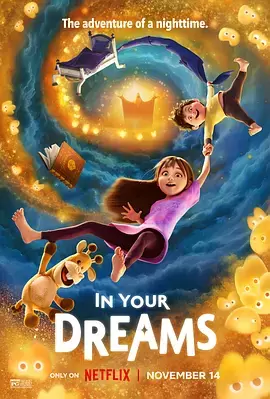
6.5In Your Dreams
Story Overview
Mar 5, 2026Stevie and his brother Elliott embark on a wild and absurd dream journey, begging the Sandman to grant them a perfect family.
Review Highlights
5 entriesDaytime
5.0版权归作者所有,任何形式转载请联系作者。 作者:豆友r02AMbmIq8(来自豆瓣) 来源:https://movie.douban.com/review/17238841/
Daytime
版权归作者所有,任何形式转载请联系作者。 作者:豆友r02AMbmIq8(来自豆瓣) 来源:https://movie.douban.com/review/17238841/
版权归作者所有,任何形式转载请联系作者。 作者:豆友r02AMbmIq8(来自豆瓣) 来源:https://movie.douban.com/review/17238841/
Daydream Adventure was better than I expected; it even made me cry. I was initially worried it would be too similar to Pixar's Inside Out, but it wasn't; the story is quite original. For example, the Sandman, the dream god, the many adorable sand sprites, and the numerous nightmare scenarios are all very fresh. Especially noteworthy is its perspective on the anxieties and fears children experience due to major life changes like having a second child, divorce, separation, or moving—it reminds me of my own childhood anxieties. The story is suitable for all ages, and I especially think parents should watch it. Many parents make decisions without considering their children's feelings, but children understand everything and experience overthinking and anxiety. Home is their safe haven, and any change can cause worry and emotional distress. Besides the novel and insightful perspective, most of the plot is hilarious. There are many adorable food characters. The process of the siblings going from arguing to disliking each other to reconciliation is also very touching. However, I find it a little hard to believe that siblings from the same family have such different personalities. I think it still has a chance to be nominated for an Oscar; the biggest obstacle is that my family already has a blockbuster film.
An Imperfect Reconciliation: How "Daydreams" Embraces the Cracks in Reality
4.0版权归作者所有,任何形式转载请联系作者。 作者:冷月清秋(来自豆瓣) 来源:https://movie.douban.com/review/17472960/
An Imperfect Reconciliation: How "Daydreams" Embraces the Cracks in Reality
版权归作者所有,任何形式转载请联系作者。 作者:冷月清秋(来自豆瓣) 来源:https://movie.douban.com/review/17472960/
版权归作者所有,任何形式转载请联系作者。 作者:冷月清秋(来自豆瓣) 来源:https://movie.douban.com/review/17472960/
While Disney and Pixar animations have established a precise formula for happiness, a film called *In Your Dreams* chooses to inject a dose of sobering reality into its dreamlike backdrop. This Netflix animated feature, directed by former Pixar story artist Alex Woo, tells the story of a brother and sister who venture into a dream world to find the "Sleeping Beauty" in order to save their parents' crumbling marriage. It boasts vibrant colors and fantastical adventures, yet at its core, it explores a less dreamlike theme: when dreams are destined to remain unfulfilled, when perfection is unattainable, how do we reconcile with this fractured reality?
Rather than a fairy tale about escapism, this is more of a story about the disillusionment of control. The protagonist, Stevie, is a typical Type A personality, a "troublemaker" in her family, acutely aware of the underlying cracks in her parents' silence. Thus, her and her brother's dream adventures are essentially a meticulously planned project: finding an omnipotent god to mend everything. The director projects his own personality onto the protagonist, and Stevie's pursuit of perfection is a reflection of the controlling child within every modern person. However, the film's greatest strength lies not only in its portrayal of a girl's awakening but also in its gentle deconstruction of the "fairy tale narrative" itself.
This deconstruction is first and foremost reflected in its treatment of the "villains." The film cleverly avoids portraying the root of the real-life predicament—the parents—as villains. There are no fierce arguments, no dramatic betrayals, only a gradual estrangement caused by life's pressures (financial anxiety, job transfers). The conflict is internalized as silent dinner tables and a solitary figure drinking alone. This realistic approach allows the film's core issue to transcend simple "right and wrong," directly addressing the pervasive weariness and helplessness of the adult world. The true villain, the "Nightmare Queen" Nightmara, is not a specific bad person, but rather a personification of the protagonists' inner fear—the fear of their family falling apart.
The construction of the dream world is a concrete manifestation of this deconstruction process. The floating islands, talking food, and mad dolls, seemingly absurd, are not a haven from reality, but rather a distorting mirror reflecting it. The most brilliant settings are "Breakfast Town" and "Zombie Breakfast Food," which transform the most ordinary yet anxiety-prone ritualistic scenes in the home into threatening adventure arenas. This reveals a cruel truth: the dream world Steveny tries to escape into is precisely a distorted projection of her real-life anxieties. The film thus completes its core dialectic: the pursuit of a perfect dream is essentially a painful acknowledgment of the flaws in reality; and escaping the dream is the beginning of accepting reality.
Another moving aspect of the film lies in its redefinition of the source of "redemption." Stevie's imagined savior is the Sandman, capable of granting any wish, while reality presents her with her troublesome and complaining brother Elliot, and the giraffe doll Baronny Tony, whose every utterance is a dry joke. This combination of a control freak and a "chaos maker" forces Stevie to let go of her obsession with perfect procedures. The director frankly admits that Stevie's relationship with Elliot stems from her genuine affection for her "unreliable" brother. Therefore, the core arc of the story is not the realization of the fantasy of "perfect family," but rather Stevie finally "seeing" her imperfect yet real brother beside her. The real magic is not the miracle bestowed by the Sandman, but the siblings' hands clasped tightly amidst the chaos.
Admittedly, as Kuku Studios' debut film, the narrative pacing and plot development are somewhat immature, with issues such as disjointed scenes and insufficient exploration of supporting characters. However, perhaps this "imperfection" is precisely what creates an intertextual connection with its theme. The director named the studio "Kuku," a homophone for "cry" in Chinese, hoping to tell stories that evoke both laughter and tears of empathy. This film is precisely such a tear. It tells us that the resilience of a family lies not in the absence of cracks, but in the members on either side of those cracks still choosing to draw closer to each other. When Mozart's "Turkish March" plays, the family doesn't return to the happy ending of a fairytale, but they learn to hum along together at their imperfect, yet uniquely their own, dining table. Perhaps this is the most precious surprise life offers us after waking from a daydream.
A messy animation, but worth discussing.
3.0The animated film *In Your Dreams* was directed by Alex Wood, who previously worked at Pixar Animation Studios, serving as Story Artist (focused on the visual creation of specific storyboards) and Story Lead (focused on the overall creative control and team coordination) for six Pixar animated films, including: *Ratatouille* (2007), *WALL-E* (2008), *Cars 2* (2011), *The Good Dinosaur* (2015), *Finding Dory* (2016), and *The Incredibles 2* (2018). In 2016, he left Pixar to found his own independent animation studio, Kuku Studios. The name "Kuku" comes from the Chinese word "kū," meaning "to cry," reflecting the studio's goal of creating works that evoke both "tears of laughter and tears of pathos." "Daydreams" is the studio's first animated film since its founding, with Alex Wood serving as director and screenwriter (co-director), and high hopes placed on the film. 版权归作者所有,任何形式转载请联系作者。 作者:魏豆子(来自豆瓣) 来源:https://movie.douban.com/review/17201385/
A messy animation, but worth discussing.
The animated film *In Your Dreams* was directed by Alex Wood, who previously worked at Pixar Animation Studios, serving as Story Artist (focused on the visual creation of specific storyboards) and Story Lead (focused on the overall creative control and team coordination) for six Pixar animated films, including: *Ratatouille* (2007), *WALL-E* (2008), *Cars 2* (2011), *The Good Dinosaur* (2015), *Finding Dory* (2016), and *The Incredibles 2* (2018). In 2016, he left Pixar to found his own independent animation studio, Kuku Studios. The name "Kuku" comes from the Chinese word "kū," meaning "to cry," reflecting the studio's goal of creating works that evoke both "tears of laughter and tears of pathos." "Daydreams" is the studio's first animated film since its founding, with Alex Wood serving as director and screenwriter (co-director), and high hopes placed on the film. 版权归作者所有,任何形式转载请联系作者。 作者:魏豆子(来自豆瓣) 来源:https://movie.douban.com/review/17201385/
The animated film *In Your Dreams* was directed by Alex Wood, who previously worked at Pixar Animation Studios, serving as Story Artist (focused on the visual creation of specific storyboards) and Story Lead (focused on the overall creative control and team coordination) for six Pixar animated films, including: *Ratatouille* (2007), *WALL-E* (2008), *Cars 2* (2011), *The Good Dinosaur* (2015), *Finding Dory* (2016), and *The Incredibles 2* (2018). In 2016, he left Pixar to found his own independent animation studio, Kuku Studios. The name "Kuku" comes from the Chinese word "kū," meaning "to cry," reflecting the studio's goal of creating works that evoke both "tears of laughter and tears of pathos." "Daydreams" is the studio's first animated film since its founding, with Alex Wood serving as director and screenwriter (co-director), and high hopes placed on the film. 版权归作者所有,任何形式转载请联系作者。 作者:魏豆子(来自豆瓣) 来源:https://movie.douban.com/review/17201385/
The film's plot is simple: facing a family on the verge of falling apart, twelve-year-old Stevie and her brother Elliot enter a fantastical dream world, begging the Sandman to grant them a perfect family. After a series of adventures, she finally realizes that life is inherently imperfect, and so is family; dreams alone cannot change anything. In the end, the family reunites and begins a new life.
This film shows many influences from Pixar and DreamWorks (such as Inside Out), and while the story is original, it can be said to be somewhat clichéd. It has the following two advantages.
One of its strengths is its skillful portrayal of parental conflict and the child's reactions, focusing on the stress children experience due to anxiety and perfectionism.
Many films tend to demonize one or both parents when depicting marital breakdown, but this film avoids this by not portraying a single truly at fault. The couple in the film don't do anything to hurt each other; they continue to strive for their family, just in different directions. This "no bad guys" approach presents the gap between adults from a mature perspective, while employing an expressive style that resonates with both children and adults.
Meanwhile, in typical family movies, parents think about one set of things, while children think about another set, with parents often feeling that their children don't understand anything and shouldn't understand anything. However, this film takes a different approach, presenting observations and feelings from the perspective of a 12-year-old girl. Steve is an A-grade student with a clear perfectionist tendency, believing that life and family should be perfect. Therefore, she keenly notices the unusual aspects of her family and tries to salvage the situation by making breakfast and other means within her power. However, her inner anxiety still makes her prone to worry and she tells her younger brother about her imagined separation, divorce, and the arrival of new siblings.
These two aspects make this film a family-friendly viewing experience, allowing audiences of all ages to enjoy it, resonate with it, and even potentially gain something from it. Beneath its humorous and endearing style, the film conveys profound life lessons in a delicate and sincere way, making its core message deeply resonate with viewers without ever feeling didactic or preachy.
Secondly, the presentation of the dream scenes is highly creative, the audiovisual effects are quite stunning, and the voice actors' performances are of high quality and full of emotion.
Whether it's the terrifying dreams created by Nightmara or the entire dream realm, both encompass the film's most gripping and hilarious moments. Visually, these scenes are a feast for the eyes, with vibrant colors leaping off the screen. Several interspersed 2D animated scenes are novel and interesting, showcasing the animators' superb skills. It's worth noting that the film doesn't just feature things like "hot dogs" and rainbow "laser farts" to make people laugh; it also depicts scenes of teeth falling out and food turning into zombies (related to horror scenes, no images provided), perfectly reflecting the "good and bad" nature of dreams in reality. 版权归作者所有,任何形式转载请联系作者。 作者:魏豆子(来自豆瓣) 来源:https://movie.douban.com/review/17201385/
The film's soundtrack perfectly complements the characters and scenes, captivating audiences with its powerful music. The thrill of flight, the awe-inspiring grand scenes, and the tension of impending doom are all conveyed through the music. Also noteworthy are the cleverly integrated classic tracks, including "Sweet Dreams" by The Eurythmics, and two songs tailor-made for "Sandman"—one a cover of the 1954 classic by The Chordettes, and the other sampling a fragment from an equally classic Metallica track.
As for the voice actors, the father (Simu Liu) and mother (Kristen Milioti) are of a solid standard, the Sandman (Omid Giallie) and Nightmare (Gia Caddis) each have their own unique characteristics, and Baloney Tony (Craig Robinson) is humorous and witty. Particularly outstanding are the voice acting for the older sister (Julie Wong Rappaport) and younger brother (Elijas Jansen), whose voices are both fitting to their personalities and endearing, adding a lot to the film.
Of course, as the studio's first independent animated film, this film is indeed a bit messy, with a feeling that it tries to say everything but doesn't say anything well, and inevitably has the following shortcomings .
One drawback is that the visual style imitates the works of other large studios too much, giving people a sense of déjà vu.
The second drawback is that Baron Tony is more of a simple comedic character, only mentioned briefly in the scene where the siblings are playing claw machines. The story itself is not rich enough, and the comedic effect is also limited.
The third drawback is that the story arrangement is somewhat disjointed, sometimes in reality, sometimes in a dream, and sometimes what seems like reality turns out to be a dream, and the duration varies. In addition, there is a montage, which makes it easy for the audience to get confused, even though they can understand it.
Fourthly, considering that the entire film is only 80 minutes long excluding the end credits, some world-building and character development could have been explored more thoroughly, but were not explored in depth, such as the marital conflict, the sibling relationship, and the story between Sandman and Nightmare.
Fifthly, some plot points that were introduced early on were left unresolved (plot holes left unfilled). For example, Baron Tony says "We'll meet again in our dreams" when they part, but this isn't shown in the end; the female lead's romantic storyline is mentioned twice but not resolved; and the band is mentioned multiple times in the film, but the ending only briefly mentions "Father is going to form another band." Of course, one could argue that this was to leave room for a sequel.
In short, as the studio's first production, this animated film is certainly passable, but there is still a lot of room for improvement before it reaches the top tier.
However, after watching the film, a question arises: just like the Infinite Tsukuyomi in Naruto, is the dream world really that bad? What if a good younger brother also appeared in the dream (after all, parents can be created)?
Protecting your beautiful dreams is the stumbling block; what you need most is reality.
5.0版权归作者所有,任何形式转载请联系作者。 作者:Llorando(来自豆瓣) 来源:https://movie.douban.com/review/17201656/
Protecting your beautiful dreams is the stumbling block; what you need most is reality.
版权归作者所有,任何形式转载请联系作者。 作者:Llorando(来自豆瓣) 来源:https://movie.douban.com/review/17201656/
版权归作者所有,任何形式转载请联系作者。 作者:Llorando(来自豆瓣) 来源:https://movie.douban.com/review/17201656/
Everyone wants their dreams to come true. The Dream King Sandman said, "When you forget that a dream isn't real, it comes true." That's very tempting, isn't it?
"In Your Dreams" tells you about the necessity of nightmares and hell. It says that reality is more important than anything else. Even if reality is imperfect, even if reality is painful, even if reality constantly slaps you in the face, even if reality shatters all your dreams, reality is above all else. Running away from it will not only not solve the problem, but will also create new problems.
This is the bloody and chaotic world, the world you've chosen to forge yourself in. Without truth, goodness is hypocrisy, and beauty is mere vulgarity. This is the kind of education all humanity needs for growth. Children need reality, not lies told by adults in the name of protection, not the emperor's new clothes.
In the movie, the older sister doesn't want her parents to separate, so she seeks help from the Dream King to create a beautiful dream where the family can be together forever. In this dream, the younger brother is never born, and the parents never go anywhere, so the older sister is trapped in the dream. How many people are trapped in a dream like this sister?
Those who look outward dream; those who look inward wake up. When you forget that the beautiful dream isn't real, you can't wake up.
The older sister looked outward, clinging to her own needs, unable to face reality. "Mom and Dad will separate, you will move, my brother will be born—life won't go according to your dreams." The older sister was immersed in her own dream, while the younger brother was awake.
The older sister was sad because she couldn't catch the doll, so he gave her his own. When he realized she couldn't wake up, he fell into the dream to save her. "You can't get out of your dream, so I'll overcome all obstacles to save you!" The older sister finally understood that her brother was better than any beautiful dream. She finally understood that the nightmares that terrified her were what liberated her, while the beautiful dreams that protected her were her stumbling blocks.
Nightmares temper your composure, hell refines your clarity; they nurture the dark vitality only a king possesses. The younger brother can pierce through the menacing facade because he has found what remains constant between us and clings tightly to this belief: love. The older sister lacks this belief, and thus she is trapped.
My little brother is so cute. He doesn't care if Mom and Dad are going to separate; he only cares if his sister is sad and if she's going to leave him. He's wiser than many adults. He knows to handle relationships one-on-one, rather than trying to address his own needs through the relationships between others.
Actually, my parents don't love each other as much as my older sister and younger brother do. They remind me of the brotherly love in the song "Sing Street." So what if my parents argue? So what if they don't care about us? We have each other, and we support each other's dreams.
You're not trying to escape the dream; you're trying to wake up from it. The moment you realize you're dreaming, the moment lucid dreaming begins, you possess all the magic. This is something I, someone who has frequently had lucid dreams since childhood, can assure you.
Only when you wake up will you realize which of your desires truly reflect your heart's desires, how much of your needs are built on fear, whether the meaning you're pursuing is truly yours, and how much of your life has been lived according to the expectations and indoctrinations of others. You need to tell your own brain, "I don't reject you, you fool; I simply stop responding to your patterns. I can use you, this fool, to serve my heart." That's true dream coming true.
When I was little, I was more like my brother; I could only empathize with my sister a little bit. Girls mature earlier than boys and think more, which isn't necessarily a good thing. I don't care whether my parents are together or not; it's none of my business. I've always said "it's none of my business" like this brother of mine. When my mother-in-law broke her arm, I said "it's none of my business," meaning I didn't do it.
In my diary, I wrote that my aunt asked me if I wanted my parents to get back together, and I said it was none of my business, it was their own affair. My aunt then twisted this into "your daughter doesn't want you to find another man" and told my mom, making my mom believe it was my request. Even if it were my request, isn't listening to me just using me as an excuse?
I don't cling to adults; it's so great when they're not around! I can cause trouble, the devil rises, and the whole world is mine, hahaha! I torment Grandpa; he gets up early, his wig gets thrown away, he buys me steamed buns, and he takes me hiking. When I couldn't read, I begged Mom to tell me stories, but now that I can read, I don't want her anymore. Mom won't let me listen to music, so I secretly buy it. Listening to music affects my studies, but studying affects my listening to music too!
Watching TV, playing games, building blocks, drawing, reading comic books all night until the lamp smokes, putting eggs in the closet, taking out mom's wigs, high heels and dresses to mess with, using paint as nail polish, dragging the quilt under the bed and framing someone else, turning the bed sheet into a rocking bed to fly with his younger siblings.
I was incredibly mischievous as a child, but outwardly very well-behaved. I knew who to charm, how to play favorites, and how to change my attitude incredibly quickly. I was also adept at reading people's expressions, just like a man who could read a woman's mood. When I noticed someone's sensitivity towards me back then, I thought to myself, "This child must have observed countless of his mother's expressions as a child, running away with his head in his hands when his mother raised the whip." Women who wield power at home in this world often treat their sons like castrated husbands, and their daughters as extensions of themselves, seeking genital fulfillment.
Parents often project their own fears onto their children—this is projection. They fear the truth, so they assume their children are afraid, only allowing them to read obviously nonsensical fairy tales about animals living happily ever after in slaughterhouses. They fear separation and change, so they tell their children they can't bear to be apart. They fear rejection, so they demand their children hide the truth. They feel sorry for themselves, so they tell their children they're pitiful. But who's pitiful? Who cares what you're doing? Children are arguably the most intelligent group in the world.
That's why I say parental culture is like child rape . It creates needs for you, then forces you to stay with them to meet those needs. If you have your own needs, fight for them; why impose them on your child? If you want your parents to be together, go talk to them. Don't assume this is what a child thinks. Even if a child thinks this way, it's their own business, a problem they must solve themselves. Making life decisions based on others' wishes is a lack of boundaries.
In truth, people only fiercely care for their parents when they don't have a lover. Once they have a lover, who would still cling to their parents? Even their own children would take a backseat. Putting one's lover first is the natural order. A person's heart is only so big, and their energy is only so much; they are not some god who distributes love equally to all beings.
Parents who make such sacrifices for their children will definitely regret it. Forcing themselves not to regret it means demanding sacrifices from their children: "How could you fall in love? How could you not sacrifice for the family? If you're free, won't you abandon me? Won't my very foundation collapse?" It's a case of demanding others what one desires.
If I had to say what I want, I've always longed for a peaceful and simple life. I crave the old-fashioned, unpretentious, and small joys that touch my heart. My ideal state is one without car horns, without expressionless, headless people, without bloated and empty skyscrapers—just a life that's authentic and natural. As a child, I wanted to go to Europe; later, I wanted to go to old towns; now I feel I can create this kind of life anywhere. That's how I want to be involved in the world.
I don't need to go to any healing sanctuary to receive magnetic energy; I can release my influence right here and now. I don't need any external mystical energy; I am what I am, and I already possess it. Many people's healing and awakening journeys are about escaping reality. Trying to transform one's state into something positive, peaceful, and joyful only leaves one feeling half-dead. Be what you are.
No matter how perfect your fantasy, it's still just a fantasy. Living means experiencing pain and negativity. The only thing you can do is build your own energy field to shield yourself from the fear and anxiety inherent in collective energy. You must realize that the fears you imagine are all fabricated, traces of being manipulated and devoured. The cannibalistic monster needs you to be afraid, needs you to feel helpless, needs you to be afraid to cut the umbilical cord, needs you to be unable to resist. People say people have become evil, but I haven't felt that way. I just feel that people are more fearful, more rigid, perhaps fearing that everyone is evil? I won't force myself to be fierce just because people say humans bully the weak and fear the strong; I will remain gentle and kind. If you bully me, it just means you're an idiot, and you'll be eliminated.
Living in fear is living in your mind. Don't live in your mind, live in your body. What you feel right now is what you are. If you feel drawn to something, then do it; no one can do anything to you. It's your belief that someone can do something to you that makes you feel that way. Like what I wrote before about being raped—so what? As long as you're alive, there's always hope. It's because you think about it as something serious and hopeless, with concepts like chastity and emotional trauma, that you're filled with fear.
Fear is merely an electrical current generated by your brain's nerves. If a tiger is about to eat you, you feel fear—that's protection. But when you believe that the outside world is full of tigers, and therefore you stay indoors, you're trapping yourself. Stop acting according to your own beliefs. Your beliefs are confining you. If you must believe something, then believe the opposite! Once you take the first step towards change, everything else will fall into place, even if there's some turmoil. It's your perception of difficulty that makes it difficult; your self-suggestion is a self-fulfilling prophecy that you will achieve your goal.
If self-censorship will always exist, then give the middle finger to this camera. Let others see, let them see, let the world see, let God see, let everything see. You live to be seen. Whoever hates you, hate them too, or ignore them, or embrace them, anything goes, just don't let being disliked bind you. You don't need courage, you need to step out of your mind.
Live with your senses, not your mind. Your senses touch reality, your mind creates illusions. It contains too much of your past and too much nonsense fed to you by others. No one can truly understand what you feel with your heart—no one but you. This is your life, and only you can decide its course.
I used to be afraid of certain people. When I saw news about domestic violence, I felt he would hit me, even though I sensed he would never do such a thing. I believed marriage was a prison, and I felt he proposed to imprison and bind me, even though he had no such intention. I had paranoia about him. I projected the ridiculous conclusions my parents instilled in me and the absurd conclusions I made onto both of us, which was utterly laughable.
What is the truth? It's that he loves me so much that he wants to push me into a world without him, because he believes he would be a burden to me. He is trapped by his own beliefs and feels ashamed and guilty about his constant instability. That's how I perceive him.
What is reality? It's the constant oscillation between sleep and wakefulness. David Tao said his song "Love, It's Simple" was ahead of his time; many of my articles are also ahead of my time; and many of someone's words are ahead of their time. That moment of inspiration, that burst of energy, and then a lifetime of living out those inspirations. You may not have better inspiration, but you can have a better life.
You don't need to be afraid of yourself. When you go free, you will not destroy the world, nor can you be destroyed by anything.
the movie "Blasphemy".
4.0In Netflix's big data production, this film exceeded expectations. The director used big data from *Inside Out*, and we can even see higher-dimensional spaces like *Sleepy Holmes* and *Interstellar*.
the movie "Blasphemy".
In Netflix's big data production, this film exceeded expectations. The director used big data from *Inside Out*, and we can even see higher-dimensional spaces like *Sleepy Holmes* and *Interstellar*.
In Netflix's big data production, this film exceeded expectations. The director used big data from *Inside Out*, and we can even see higher-dimensional spaces like *Sleepy Holmes* and *Interstellar*.
The dream and nightmare sequences are imaginative, using dreams to explore the family problems and the issue of having a second child through the older sister's perspective, concretizing real-life issues, and redefining family relationships within the dream world, learning to accept life's imperfections. We need more than just good dreams; we also need nightmares.
This positive and uplifting message is perfect for this kind of children's animated film.