
 9.1
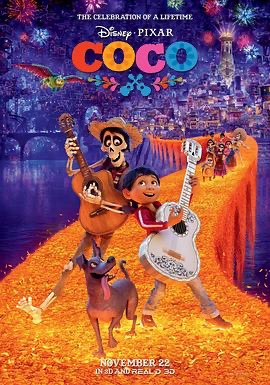
9.1Coco
Story Overview
Jun 26, 2025Miguel (voiced by Anthony Gonzalez), a young boy who loves music, is unfortunately born into a family that sees music as a forbidden menace. His family hopes that Miguel will grow up quickly to inherit the shoe-making business that has been passed down for generations. As the annual Day of the Dead approaches, on this day, the souls of the deceased can return to the living world to reunite with their loved ones through the photos placed on the altars. In an accident, Miguel finds himself in the Land of the Dead. Before the sun rises, he must receive a blessing from a deceased relative, or else he will be trapped in this world forever. Miguel decides to search for the legendary musician Ernesto de la Cruz (voiced by Benjamin Bratt), as he might be his grandfather. Along the way, Miguel meets a down-and-out musician, Hector (voiced by Gael García Bernal), and gradually uncovers the long-hidden secrets of de la Cruz.
Review Highlights
5 entries"Perhaps you would like to learn about the Mexican elements in the film."
10.0This article offers a deep reflection on how the film *Coco* has fostered a strong sense of connection to Mexico’s upcoming **Day of the Dead**. The Pixar creators put in a lot of effort in preparing for the film, and after six years of production, the film beautifully blends many Mexican cultural elements with a heartwarming story. As the director said, “We wanted to show a Mexico that’s different from what you see in the news.” If this article helps people gain a little more understanding of Mexico or gives them a moment of "getting the joke" while watching the movie, that would be a very happy thing.
"Perhaps you would like to learn about the Mexican elements in the film."
This article offers a deep reflection on how the film *Coco* has fostered a strong sense of connection to Mexico’s upcoming **Day of the Dead**. The Pixar creators put in a lot of effort in preparing for the film, and after six years of production, the film beautifully blends many Mexican cultural elements with a heartwarming story. As the director said, “We wanted to show a Mexico that’s different from what you see in the news.” If this article helps people gain a little more understanding of Mexico or gives them a moment of "getting the joke" while watching the movie, that would be a very happy thing.
This article offers a deep reflection on how the film *Coco* has fostered a strong sense of connection to Mexico’s upcoming **Day of the Dead**. The Pixar creators put in a lot of effort in preparing for the film, and after six years of production, the film beautifully blends many Mexican cultural elements with a heartwarming story. As the director said, “We wanted to show a Mexico that’s different from what you see in the news.” If this article helps people gain a little more understanding of Mexico or gives them a moment of "getting the joke" while watching the movie, that would be a very happy thing.
At the start of the movie, the **papel picado** (paper cut-outs) can be seen, which is very common in Mexico. Recently, when visiting a ranch where a wedding was about to take place, the corridors were lined with white papel picado featuring ring designs, symbolizing purity and joy. Interestingly, this is somewhat similar to Japan, but the opposite of China. During holidays like national festivals or Day of the Dead, colorful papel picado often decorates the streets.
Mexicans really love color. It’s common to see houses painted in vibrant hues, with entire blocks of streets creating a striking visual spectacle.
**Guanajuato**, often referred to as the "city of God's spilled paint," is known for its beautiful streets filled with color.
Later, the movie features **tamal**, a traditional Mexican food made by wrapping chicken or pork, vegetables, chilies, and sauces in a thick layer of corn flour and steaming it in corn husks. This is similar to China’s zongzi. Although corn is a staple food in Mexico, many Mexicans don’t particularly enjoy tamales due to the thick corn flour layer. According to sources, this type of "dumpling" can also be found in many Central and South American countries, with slight variations in preparation and ingredients.
The family in the film, the **Riveras**, has been in the shoe-making business for generations. This ties into Mexico’s economy, where family-run small and medium-sized businesses are the backbone. Many traditional family-run workshops in the past were shoe-making businesses.
In the movie, **Mamá Imelda** raises her daughter single-handedly and establishes the family’s livelihood. In Mexico, this is very common. Although Mexico has a "machismo" culture (strong male dominance), many aspects of Mexican society reflect matriarchal traits, where women often take on greater responsibility for the family’s daily life and decisions. As Mamá Imelda says, "He wanted to sing, to reach bigger stages, but for me, putting down roots in life and focusing on family was more important than music."
A conversation with a 90-year-old woman at home, similar to the character Mamá Coco, resonated with this sentiment. Once, she mentioned, "Los hombres no valen nada" (Men are good for nothing). In her younger days, women had to do everything—taking care of the house, managing inside and outside, while the men were mostly "figureheads," which aligns with what’s portrayed in the film.
The **Plaza de Mariachi** that appears in the film is a reference to the traditional Mexican music genre, **Mariachi**. Musicians and singers wear **sombreros**, which have large brims designed to block the sun.
**Mariachi music** in the film is full of depth and passion. The Spanish versions of songs like *Recuérdame* and *Como Loco* are emotionally intense and much more powerful than their English counterparts, which is typical of Mexican singing style.
In the film, the people in the small town gather in the plaza for various activities, reflecting how life in Mexican villages often revolves around community spaces. Much like rural life in China, villages remain a core administrative and geographical unit for Mexicans, especially in the south. Mexico is home to over 100 **Pueblos Mágicos** (Magical Towns), where farming, livestock, and handicrafts are common professions.
The character **Ernesto de la Cruz** in the film is inspired by the famous actor and singer **Pedro Infante**, a beloved figure in the golden age of Mexican cinema.
Mamá Imelda, the oldest family member in the movie, is modeled after the legendary actress **Maria Félix**, also from the golden age of Mexican cinema.
An amusing line in the film is when the boy Miguel says, “We’re probably the only Mexican family that doesn’t like music.” This is very accurate; Mexicans are passionate about music, and even young people enjoy traditional mariachi.
The town in the movie where the living people reside is called **Santa Cecilia**, which doesn't exist in real life but is named after the Mexican patron saint of music.
In the movie, there’s also a funny dog named **Dante**, who plays an important role in the Day of the Dead tradition. Dogs are believed to guide souls in the afterlife, helping the departed cross into the next world. The dog cannot be too dark, or people would not be able to see it on the journey; nor can it be too light, as it would refuse to go to dirty places. This idea reflects the cultural view that the underworld is a messy place.
Dogs have always held a significant role in Latin American cultures. In **Teuchitlán**, Jalisco, where there is an ancient civilization believed to predate the Maya and Aztec civilizations, dogs were often found in graves, buried as companions to the deceased, just like China’s **Terracotta Warriors**.
**Guanajuato**, a city known for its stunning scenery and good security, is said to be the inspiration for the afterlife world in the film. A towering skyscraper in the afterlife world depicts the current state of Mexico: the less-developed southern regions, the commercial center of the middle, and the industrial north.
In the movie, **Cempasúchil** flowers form a bridge that souls use to travel back to the living world. These marigold flowers are said to symbolize the sun’s rays, guiding the dead home, making them a prominent decoration for the Day of the Dead.
A scene that deeply moved a young girl watching the film was when it seemed that the deceased could truly return to the world of the living by crossing a bridge of marigolds.
**Alebrijes** are mythical creatures that also appear in the movie. The story of how they originated is fascinating: a craftsman, while very sick with a high fever, dreamt of a group of wild beasts, shouting "alebrijes," and upon waking, he spent days creating the creatures from his dream. This eventually led to **Frida Kahlo** and **Diego Rivera** purchasing them, and they became iconic in Mexican culture.
In the movie, **Frida and Diego** appear briefly, showcasing their enduring cultural significance.
The appearance of **El Santo** in the film, a legendary figure in Mexican **Lucha Libre** (freestyle wrestling), is also noteworthy. Lucha Libre is an important part of Mexican life, where wrestlers not only fight but also put on performances for entertainment. The crowd's interaction with the fighters is a major part of the show, and as the saying goes, "the wilder, the more enjoyable."
The underground **cenote** (a natural well) seen later in the film is an iconic Mexican geographical feature, specifically in the Yucatán Peninsula. The ancient Maya believed cenotes were gateways to the underworld and used them for human sacrifices.
Finally, the story unfolds during **Día de Muertos** (Day of the Dead), an incredibly important day for Mexicans. On this day, the spirits of the deceased return to the living, transcending life and death. This reflects the Mexican attitude towards death: it is not seen as a sorrowful event but rather as a celebration, as the deceased enjoy the afterlife, with music, dance, and parties. They return annually to reunite with their loved ones, so no one truly says goodbye.
In 2008, the **UNESCO** recognized Día de Muertos as an intangible cultural heritage.
The Mexican practice of remembering the dead can be traced back to **Aztec** traditions, and over time, the celebration blended with European religious customs during colonization.
During Día de Muertos, people often paint themselves as skeletons, like the way **Héctor** paints **Miguel** in the movie, and celebrate together with their unseen ancestors.
The directors describe Mexico as a “vibrant country filled with culture and warm people,” and I wholeheartedly agree.
This Pixar animation, which looked unpromising, delivered an extraordinary surprise.
10.0I’ve just watched *Coco* a few days ago, and even now, while writing this article, I am still filled with excitement.
This Pixar animation, which looked unpromising, delivered an extraordinary surprise.
I’ve just watched *Coco* a few days ago, and even now, while writing this article, I am still filled with excitement.
I’ve just watched *Coco* a few days ago, and even now, while writing this article, I am still filled with excitement.
Before watching the movie, I didn’t have much impression of it. I only knew that it was a Pixar film, about Mexico’s Day of the Dead, based on a few short reports and a trailer. I couldn’t spot any highlights from the preview either. Adding to that, Pixar’s performance in recent years has been a bit unstable, so I had a neutral attitude towards it. However, when the credits rolled, I couldn’t get up for a long time due to the immense surprise and emotional impact.
This will absolutely win the Oscar for Best Animated Feature next year. If it goes to someone else, I’ll live-stream myself eating a pound of Mexican chicken wraps.
Among Pixar’s films, *Coco* looks quite simple. It doesn’t have the cute characters of *Finding Nemo* or *Wall-E*, nor the original themes and childhood nostalgia of *Toy Story* series. It doesn’t even have the creativity of *Monsters, Inc.* or *Inside Out*. Of course, Pixar’s ability to create alternate worlds is still excellent, but the Land of the Dead in this film doesn’t give a spectacular impression at first glance.
On the contrary, the film heavily relies on Mexican culture, which most people—especially in our country—aren’t very familiar with. From the Mexican papel picado (cut paper art) at the beginning to the traditional foods, customs of the Day of the Dead, marigolds, and even the fantastical creatures, most viewers probably wouldn’t understand their significance. There are also a lot of skeleton characters in the film, and even though they are extremely cartoonish, they might not be endearing to children. They might even get scared. Then there’s that ugly and dirty Mexican hairless dog, which definitely can’t become the cute mascot of the movie. Pixar has taken a more daring approach this time, not aiming for “approachability” in the way they usually do.
On one hand, this might lead audiences, who care more about visuals and entertainment, to ignore the film because they don’t relate to the Mexican culture or art style. On the other hand, it also demonstrates the strength of Hollywood animation’s ability to blend different cultures. From *Kung Fu Panda* to *Rio* to *Brave*, we’ve seen how Chinese martial arts, Latin American vibes, and Scottish culture can seamlessly merge with Hollywood aesthetics. Pixar/Disney, the most famous name in the industry, excels at this.
Maybe even the title reveals something about the film’s core theme, which is closer to *Up*. In terms of emotional depth, it also echoes *The Incredibles*. This is a tear-jerking film about pursuing dreams, but it also addresses death, memory, farewell, and reconciliation. It’s a very Hollywood-style story but one that’s not bound by conventional formulas.
The “unconventional” subject matter adds a layer of mystery to the film. Once you peel back the layers, you’ll experience the heartfelt emotions at its core. Like other Pixar films, it’s emotional without being overly sentimental, and the tear-jerking moments surpass the famous montage in *Up*.
In short, although *Coco* might not seem particularly appealing on the surface, it builds a vast emotional impact piece by piece with a solid story and well-developed characters, leading to a powerful emotional explosion that will make you tear up.
On the technical side, the film is at the top of the industry, just like other Pixar films. From art design to CGI production, everything is flawless. One of the details that left a deep impression on me was the realistic depiction of tree branches and leaves, as well as the folds and movement of clothing. Another was the portrayal of Coco, the protagonist’s great-grandmother, who’s mostly sitting in a wheelchair with few lines but plays a vital role in the film. Coco’s hair and wrinkles were likely the most carefully sculpted part of the character.
Besides that, *Coco* is full of musical scenes with guitar playing. As a guitar enthusiast, I instinctively paid attention to whether the finger movements on the animation were accurate. I was pleased to find that the film didn’t cut corners in this regard. The scenes where Miguel secretly plays guitar in the attic, the strumming rhythm, and finger movement were all perfectly in sync with the guitar sound, almost identical to live performances. The flamenco guitar pieces in the film were also delightful to listen to.
These details make the virtual characters feel closer to the audience and add to the story’s believability. It’s clear that everything in the film was done with the ultimate emotional payoff in mind.
Compared to *Inside Out* and *The Incredibles*, *Coco* is more mature in nature. Not only because it abandons the usual cute style, but also because its narrative style is more restrained, without the over-the-top imagination. Although the story of young Miguel traveling to the Land of the Dead is still based on a fantastical theme, the depiction of the underworld isn’t meant to be appealing—it's more eerie and even frightening. We see that even in the Land of the Dead, there’s still poverty and hunger, and the concept of "final death". For an animated film, *Coco* is rare in that it addresses and reflects on death.
The atmosphere of the setting adds a layer of subtle sadness to the film. This muted sadness constantly affects the characters and subtly influences the audience as well.
One of the first scenes to clearly convey this is when Hector explains “final death” to Miguel. It’s an insightful moment, a few simple lines that tie the unbreakable bond between life and death. The sorrow over separation and remembrance is thought-provoking. However, in keeping with Hollywood’s tone, the film soon shifts focus back to the protagonist’s adventurous journey, cutting off the emotional aftertaste.
The film’s treatment of death primarily focuses on the inseparable bond between the living and the dead. Since the story takes place on the Night of the Dead, the living eagerly await the return of the deceased, and mourning becomes part of the celebration. This gives the film a tone that isn’t dark or negative, but still carries sadness and remembrance. In balancing these two moods, *Coco* is probably Pixar’s least funny film, yet it maintains a light and hopeful vibe. The film’s strength lies in the qualities that make a good movie: fully fleshed-out characters, a convincing and winding story, and the intense emotions that arise.
The film begins by using papel picado to tell the history of Miguel’s family. Here, we see a separation and the single mother’s resilience and strength. The film first asks the question: should one abandon family for the sake of pursuing a dream? This theme will run throughout the film and ultimately give an answer through reconciliation. The use of papel picado as a storytelling device is also quite fresh, allowing the audience to quickly immerse themselves in the story.
In the first half of the film, we are all concerned about whether Miguel will achieve his dream of music. We hope he’ll pick up the guitar and join the contest in the square. We might even support him in defying his controlling family. Through various life details, the audience naturally empathizes with Miguel. But this is precisely the trap the creators set. In the second half, as the story twists and turns, we, like Miguel, realize what is truly important in life. We find that except for the true antagonist, no one has truly done anything wrong, and all the conflicts stem from that inseparable emotional bond with family. At this point, the character arcs are fully revealed, and emotions are expressed in full. The audience is easily moved, and tears flow involuntarily.
Another clever narrative element in the film is how the marigold and Hector’s photo are used to connect the entire adventure. These items become crucial at key moments but fail at other times, adding tension and speeding up the story’s pace, which leads to several climactic moments.
I haven't seen such a well-structured, emotionally rich script in an animated film in a long time. The clear storylines and rational character motivations make every choice the characters make believable. And each choice leads to a bigger, more complex story, ultimately reaching the climax.
The latter part of the film features a plot twist that’s both surprising and inevitable. This twist is a brilliant stroke in the genre, setting up the joke in a very clever way without being forced, and it brings the audience’s attention back to earlier hints without using any clumsy flashbacks (though the explanation afterward uses necessary flashbacks). The plot twist brings the entire story to a "high point", which is successfully sustained until the end.
Looking back, the entire theme of the story undergoes an internal shift, from pursuing personal value to correcting the trajectory of fate, and finally to a deep understanding of family bonds. The essence of the story is quite tragic, reflected in both Miguel’s family history and Hector’s past. The story’s adventurous plot allows the characters to change their attitudes toward family, embrace kinship again, and allow Miguel to grow through self-reflection.
This solid script deserves all the praise. It once again proves that Pixar has top-tier storytelling abilities, capable of bringing out the most exciting aspects of a story. In fact, the narrative structure and themes of *Coco* are not new to commercial films, but Pixar has the ability to make them shine, radiating a deep emotional power that touches the heart.
In my view, *Coco* is undoubtedly an Oscar-level animation film, with timeless quality that will stay with audiences long after the credits roll. It also reminds us that death is not a permanent farewell—forgetting is. If this story can shine so brightly, I wouldn’t mind seeing more of these somewhat “cliché” universal values being expressed.
However, given Pixar
’s past box office performance in China, which has often been disappointing (with only \$1.4 billion in total revenue from 11 films in the past 20 years, contributing only 1.3% of Pixar’s global total of \$10.7 billion), and the inherent limitations of the subject matter this time, I don't have high hopes for its market performance. Still, I privately hope it can become a phenomenon like *Zootopia*, because Miguel's journey through the underworld touches the softest parts of people’s hearts.
What tear - jerking details are there in Coco?
10.0One of the most touching details for me was at the end of the film. Coco, now over a hundred years old, still wears the same two little braids she had as a child.
What tear - jerking details are there in Coco?
One of the most touching details for me was at the end of the film. Coco, now over a hundred years old, still wears the same two little braids she had as a child.
One of the most touching details for me was at the end of the film. Coco, now over a hundred years old, still wears the same two little braids she had as a child.
When she reunites with her father in the Land of the Dead, she calls out to him with the same innocent joy, "Papa," just like when she was a little girl. Her father gently takes her hand.
Despite Coco looking older than her father, the moment feels completely natural. I think it shows that, no matter how many years pass, how many life stages one goes through—even becoming a parent or a great-grandparent—when we are with our parents, we will always be their child.
Death is not the end—forgetting is.
8.0When I watched the trailer, I thought this collaboration between Disney and Pixar was going to be a simple music dream-chasing movie, like *Rock Dog* or *Sing*.
Death is not the end—forgetting is.
When I watched the trailer, I thought this collaboration between Disney and Pixar was going to be a simple music dream-chasing movie, like *Rock Dog* or *Sing*.
When I watched the trailer, I thought this collaboration between Disney and Pixar was going to be a simple music dream-chasing movie, like *Rock Dog* or *Sing*.
After watching it, I realized that chasing dreams was just a guiding thread; the movie is more about exploring family bonds and touches on the eternal theme of death.
This is an animated movie about Mexico's Día de Muertos (Day of the Dead).
Día de Muertos is a traditional holiday that Mexicans value deeply. They believe that those who have passed away aren’t truly gone but continue living in another world. On this day, they come back to the real world to reunite with their families.
That’s why the entire country celebrates this day with great enthusiasm, making skull decorations out of paper, making skull-shaped treats, wearing skull masks, singing, dancing, and celebrating without any sadness.
The story in the movie takes place on the night of Día de Muertos.
A lot of strange events happen that night. A young boy enters a dazzling, bustling world filled with skeletons, where he embarks on his dream-chasing journey to find his deceased musical idol. Along the way, many bizarre and delightful things unfold.
However, the story isn’t particularly novel. Fox had made an animated movie called *The Book of Life*, which was also set during Día de Muertos, and the main character carried a guitar; similar skeleton motifs, like those in *Corpse Bride* or *The Nightmare Before Christmas*, have been widely used before.
There are also countless films where the protagonist is passionate about music, with families who oppose their dreams; the same old family conflict. Plus, there are grand world-building efforts like in *Zootopia*, the ghost parties in *Hotel Transylvania*, the marigold bridge leading to the real world, which reminded me of the golden, dazzling stars in *Coco*.
And of course, the typical "defeat the big bad guy and complete the ultimate mission" ending. These are all familiar tropes.
But Pixar knows how to make these well-worn ideas work, and it keeps you absorbed and deeply moved.
The creative team spent six years from 2011 to the present, traveling to Mexico to do research, staying with local families, experiencing their life, and learning about their culture. They meticulously prepared every detail, from the music, colors, plot, scenes, to the character design. They spent an immense amount of time and effort to bring us vibrant, authentic visuals: colorful paper cuttings, golden marigolds, the scruffy hairless dog, traditional food resembling long rice dumplings, family-run shoe workshops, entertainment plazas, and native instruments.
The towering buildings in the land of the dead were designed using historical Mexican references, showcasing the evolution from ancient to modern times. This attention to detail is one of the reasons why Pixar’s films continue to surprise us.
Family and music are the two major elements of this film.
Thus, Pixar paid great attention to music. There are many wonderful original songs in the film, filled with Latin flair and deeply moving melodies. Over 50 musicians were involved in the production, using a variety of Mexican instruments to showcase the musical landscape.
The young boy’s guitar playing and the intricate finger placements are portrayed accurately, showing the care and emotion that went into the film.
What touched me the most was the scene where the great-grandmother sings on stage while avoiding the villain to protect a photo, and the climax when the boy and the great-grandmother sing *Remember Me* together. I loved those moments. I won't spoil the plot further here.
But I can't help but give huge credit to the animators for their work on the great-grandmother's face. The wrinkles and the tender, wise expression were so realistic and adorable. It’s the attention to these seemingly small details that truly touches us.
The movie is called *Coco* in English, named after the great-grandmother, which seems to remind us who the true protagonist of this film is. Just like in *Kikujiro's Summer*, the real lead isn’t the little boy, but the quirky adult (in that case, Kitano).
The movie itself is joyous, but perhaps because of the theme of death, it doesn't make you laugh out loud. It just makes you smile knowingly, which is enough.
A film that can bring you joy while also moving you to tears is truly remarkable. Unlike aimless comedies or those that dwell on suffering, this is an elevated work of art. This is the kind of work that has lasting value.
Like an O. Henry-style twist at the end, the first 90 minutes bombard you with vibrant, lively visuals, but in the final few minutes, with simple, quiet moments, it strikes you deeply. Unprepared and unsuspecting, you fall right into the trap the director has skillfully set, and tears immediately start flowing.
I remember that at this particular moment, the theater was unusually quiet. Everyone was holding their breath, focused on the screen, not wanting to miss any detail. You could feel everyone immersed in the beautiful emotions of love and longing.
It’s emotional without being overly sentimental, simply telling the story without preaching, hitting just the right notes.
I love films like this. We need these kinds of stories to remind and tell most people the meaning of their existence.
Death is not the final goodbye; forgetting is. If someone remembers you, and you still have a connection in your heart, that’s the greatest happiness and meaning of being alive.
Let's also talk about the finishing touches in the end credits of Pixar feature films.
8.0A Thought on "XX Production, Guaranteed Excellence"
Let's also talk about the finishing touches in the end credits of Pixar feature films.
A Thought on "XX Production, Guaranteed Excellence"
A Thought on "XX Production, Guaranteed Excellence"
Fans of Pixar are well aware that, in addition to the brilliance of their films, the studio puts a lot of effort into the end credits, which are always full of thoughtful details and highlights. It seems that since *Brave* (2012), Pixar has added a dedication after the credits roll, offering insight into the creative inspiration behind the film. This often serves as a final touch, leaving the audience with more to reflect upon.
In *Brave* (2012), in memory of their former boss Steve Jobs, the film ends with the following dedication:
**Brave (2011)** With love and gratitude, dedicated to Steve Jobs, our partner, mentor, and friend.
From my personal aesthetic perspective, *Brave* has always stood out as a unique film in Pixar's portfolio. Its visual style didn’t quite match the usual Pixar tone, which made it the only Pixar movie I’ve never watched (even *The Good Dinosaur* I watched for its scenery). So, I won’t say much more, but I just want to highlight that Pixar’s end credits dedication generally looks something like this. In *Inside Out* (2015), I, as the type of viewer who stays until the credits are finished, first encountered their dedication in this film:
**Inside Out (2015)** This film is dedicated to our children. Please, never grow up.
Fans of the film know that this work dissects human emotions into five personified characters—Joy, Sadness, Anger, Disgust, and Fear—who cooperate to help the protagonist navigate her emotions. Through their adventures, the film imparts a warm yet serious lesson: growing up doesn’t mean just moving forward with joy, but rather, it involves embracing both joy and sadness in the inevitable passage of time. The strength that this bittersweet combination brings is the greatest gift that memory and experience can offer. The film’s standout moments, from the ingenious setup of the five emotions to the whimsical settings of abstract regions in the mind, and the emotional farewell with Bing Bong and Joy, all serve to convey the core message: “growing up = having golden-blue memories.”
I remember watching the film in theaters, often struck with awe, laughing at times, and crying at others. By the end, I was completely convinced by the message they wanted to convey. But when the dedication at the end read “to our kids, please don’t grow up, ever,” I suddenly understood: Yes, you will inevitably face sadness and hardship as you grow, and I, as a parent, can’t stop that. But I hope you can embrace it bravely and with calmness. Above all, I hope you never have to face these struggles—always happy, never sad.
What a gentle and affectionate sentiment! It is said that the inspiration for this film came from director Pete Docter’s own experiences with his daughter’s growth. Perhaps this phrase, “Please, never grow up,” is something Docter wished to say to his own daughter, and behind that phrase, “never be sad,” lies the shared wish of all parents: we want you to be treated gently by the world and remain a child forever.
Speaking of Pete Docter, I must give a shout-out to this Pixar genius. Some of my favorite Pixar films are directed by him: *Inside Out* (2015), *Up* (2009), *Monsters, Inc.* (2001). He also worked on story development for well-regarded films like *WALL-E* (2008) and the groundbreaking *Toy Story* (1995). I noticed that before joining Pixar, Docter studied philosophy and visual arts, which may be one reason why his films stand out. From these films, it's clear that Pete Docter excels at combining an inspiring core message with a unique, creative concept, telling it in a warm and engaging manner that leaves you both satisfied and thoughtful.
*Finding Dory* (2016)
Next, I saw a dedication in *Finding Dory* (2016), set against a background of ocean effects:
**Finding Dory (2016)** This film is dedicated to all our families and loved ones, who help us move forward.
The most quoted line from this entry: “May you travel half your life and return still young.”
When this film was released, many criticized its somewhat childish plot. Compared to other Pixar classics and especially its predecessor *Finding Nemo* (2003), it was considered less impactful. Honestly, I agree with the aesthetic critique, but from a project management perspective, I completely understand and support Pixar’s approach. When a company like Pixar reaches a certain scale, they need more conservative projects to spread and manage risks. Moreover, Pixar, being a leader and trendsetter in the industry, like Blizzard, Google, and Apple, has a unique competitive advantage in its ability and responsibility to innovate. To maintain and strengthen this advantage, it’s perfectly reasonable for them to take a strategy that produces safe, “guaranteed hits.” So, when we see sequels like *Finding Dory* (2016) and *Cars 3* (2017) not meeting expectations, we shouldn’t prematurely judge their creativity as declining. These projects may be necessary for Pixar to continue delivering future classics and surprises.
In fact, *Finding Dory* (2017) brought Pixar a new peak in box office revenue, following *Toy Story 3* (2010). *Coco* (2017)
Finally, after two global sequels, we were treated to a new Pixar film that lived up to the brand’s expectations—*Coco* (2017). Set against a unique Mexican cultural backdrop, this fantastical story explores how we view death, life, and the significance of our relationships with our loved ones. The film tenderly reminds us: before the memories of love fade, we must strive to remember.
**Coco (2017)** Currently in theaters with a steadily increasing box office in China, the film has sparked many discussions on family, dreams, life, and death. Some viewers have questioned whether the film overly advocates a “Mexican-style family view” or whether, like *Finding Dory* (2016), it emphasizes the importance of family. From the perspective of the typical Disney storyline, it may give that impression. However, if we carefully examine the Pixar DNA within, we can see that the value of this work goes beyond that. Like *Inside Out* and *Finding Dory* (2016), *Coco* also features a dedication at the end:
**Coco (2017)** To the people across time who supported and inspired us. Thank you to those who have been with us and given us support and encouragement.
Though I couldn’t grab a screenshot since it’s still in theaters, I found a photo online. This dedication clearly resonates within the story’s worldview: souls who live on in the afterlife are either remembered for their contributions to others and society or for their sincere relationships with those closest to them. Whether you strive for greatness or remain content with simplicity, you must live your role well and walk your own path. No matter which path you choose, you can be inspiring and supportive. This is the style and height that Pixar, despite being under Disney’s capital, has successfully preserved. Highlights in Pixar’s End Credits As mentioned earlier, Pixar’s end credits always have many highlights. Finally, I’ll recommend two Pixar films that Pete Docter worked on, with end credits that stand out. One is *Up* (2009), which is my personal favorite Pixar film (I love heartwarming stories). The end credits are adorable, presented as daily life photos of the young boy and the old man, with each job title matching the content of the photo: **Script Consultant/Story Planner** – This role adds excitement to the story. The story should be told with the involvement of the person, with the protagonist’s pride, with the audience’s emotional engagement, and with the narrator’s connection. **Composer** – Someone who can hit every note in an octave. Additionally, the composer for *Up*, Michael Giacchino, is a well-known figure in film scoring. This work earned him an Academy Award for Best Score. He also collaborated with Pete Docter on *Inside Out*. This year, he composed the music for *Spider-Man: Homecoming* in collaboration with Sony and Marvel, and is also known for his work on the rebooted *Star Trek* series, whose theme melody was recently awkwardly quoted in a domestic business drama. The other standout end credits are from *WALL-E* (2008). If *Up’s* credits were cute, *WALL-E’s* credits are highly designed and artistic. The film uses key developments and styles from Western art history to showcase scenes of people returning to Earth to rebuild civilization after it was abandoned: Lastly, the Pixar logo in *WALL-E* is adorable, showing WALL-E changing the lightbulb for the little lamp—so cute!